Munsell
The Munsell color space is not registered in Color by default
Properties
Name: munsell
White Point: C / 2˚
Coordinates:
| Name | Range* |
|---|---|
h |
[0, 360) |
v |
[0, 10] |
c |
[0, 35] |
* Space is not bound to the range and is only used as a reference to define percentage inputs/outputs in relation to the Display P3 color space.
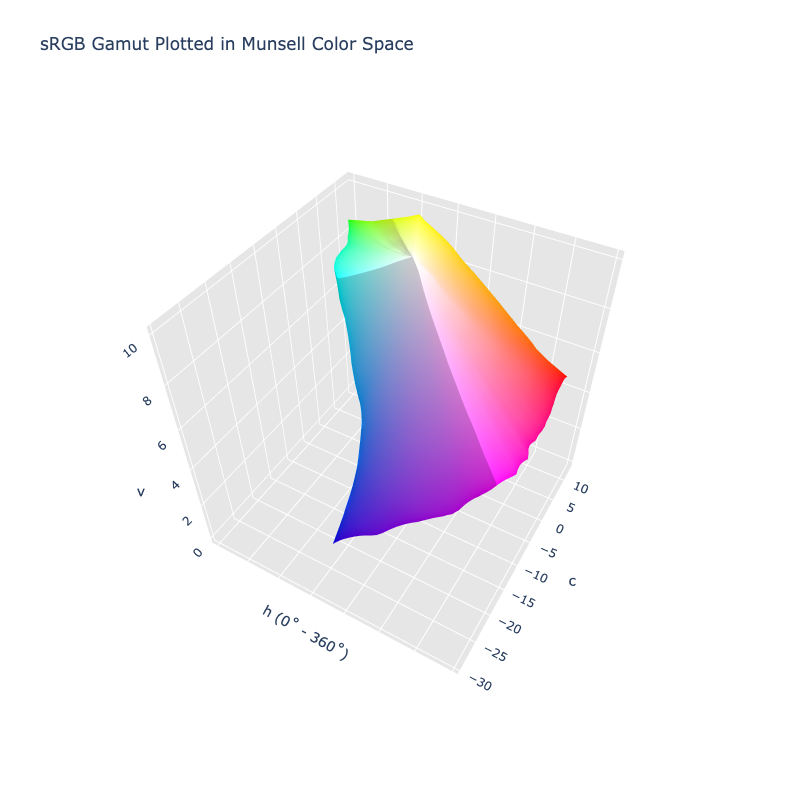
Figure 1. The sRGB gamut represented within the Munsell color space.
The Munsell color system is a color space that specifies colors based on three properties of color: hue (basic color), value (lightness), and chroma (color intensity). It was created by Albert H. Munsell in the first decade of the 20th century and adopted by the United States Department of Agriculture (USDA) as the official color system for soil research in the 1930s.
Munsell determined the spacing of colors along these dimensions by taking measurements of human visual responses. In each dimension, Munsell colors are as close to perceptually uniform as he could make them, which makes the resulting shape quite irregular.
>>> values = [9, 8, 7, 6, 5, 4, 3, 2, 1]
>>> chroma = [0, 2, 4, 6, 8, 10, 12, 14, 16]
>>> def munsell_row(hue, value, chroma_steps):
...     """Generate a row with the specified chroma steps for the a specific hue and value."""
...
...     return Steps(
...         Color('transparent') if r >= chroma_steps else Color(f'{hue} {value}/{chroma[r]}')
...         for r in range(len(chroma))
...     )
...
>>> chroma_steps = [2, 4, 6, 8, 9, 8, 6, 5, 4]
>>> for v, n in zip(values, chroma_steps):
...     munsell_row('2.5R', v, n)
...
[color(--munsell 9deg 9 0 / 1), color(--munsell 9deg 9 2 / 1), color(srgb 0 0 0 / 0), color(srgb 0 0 0 / 0), color(srgb 0 0 0 / 0), color(srgb 0 0 0 / 0), color(srgb 0 0 0 / 0), color(srgb 0 0 0 / 0), color(srgb 0 0 0 / 0)]
[color(--munsell 9deg 8 0 / 1), color(--munsell 9deg 8 2 / 1), color(--munsell 9deg 8 4 / 1), color(--munsell 9deg 8 6 / 1), color(srgb 0 0 0 / 0), color(srgb 0 0 0 / 0), color(srgb 0 0 0 / 0), color(srgb 0 0 0 / 0), color(srgb 0 0 0 / 0)]
[color(--munsell 9deg 7 0 / 1), color(--munsell 9deg 7 2 / 1), color(--munsell 9deg 7 4 / 1), color(--munsell 9deg 7 6 / 1), color(--munsell 9deg 7 8 / 1), color(--munsell 9deg 7 10 / 1), color(srgb 0 0 0 / 0), color(srgb 0 0 0 / 0), color(srgb 0 0 0 / 0)]
[color(--munsell 9deg 6 0 / 1), color(--munsell 9deg 6 2 / 1), color(--munsell 9deg 6 4 / 1), color(--munsell 9deg 6 6 / 1), color(--munsell 9deg 6 8 / 1), color(--munsell 9deg 6 10 / 1), color(--munsell 9deg 6 12 / 1), color(--munsell 9deg 6 14 / 1), color(srgb 0 0 0 / 0)]
[color(--munsell 9deg 5 0 / 1), color(--munsell 9deg 5 2 / 1), color(--munsell 9deg 5 4 / 1), color(--munsell 9deg 5 6 / 1), color(--munsell 9deg 5 8 / 1), color(--munsell 9deg 5 10 / 1), color(--munsell 9deg 5 12 / 1), color(--munsell 9deg 5 14 / 1), color(--munsell 9deg 5 16 / 1)]
[color(--munsell 9deg 4 0 / 1), color(--munsell 9deg 4 2 / 1), color(--munsell 9deg 4 4 / 1), color(--munsell 9deg 4 6 / 1), color(--munsell 9deg 4 8 / 1), color(--munsell 9deg 4 10 / 1), color(--munsell 9deg 4 12 / 1), color(--munsell 9deg 4 14 / 1), color(srgb 0 0 0 / 0)]
[color(--munsell 9deg 3 0 / 1), color(--munsell 9deg 3 2 / 1), color(--munsell 9deg 3 4 / 1), color(--munsell 9deg 3 6 / 1), color(--munsell 9deg 3 8 / 1), color(--munsell 9deg 3 10 / 1), color(srgb 0 0 0 / 0), color(srgb 0 0 0 / 0), color(srgb 0 0 0 / 0)]
[color(--munsell 9deg 2 0 / 1), color(--munsell 9deg 2 2 / 1), color(--munsell 9deg 2 4 / 1), color(--munsell 9deg 2 6 / 1), color(--munsell 9deg 2 8 / 1), color(srgb 0 0 0 / 0), color(srgb 0 0 0 / 0), color(srgb 0 0 0 / 0), color(srgb 0 0 0 / 0)]
[color(--munsell 9deg 1 0 / 1), color(--munsell 9deg 1 2 / 1), color(--munsell 9deg 1 4 / 1), color(--munsell 9deg 1 6 / 1), color(srgb 0 0 0 / 0), color(srgb 0 0 0 / 0), color(srgb 0 0 0 / 0), color(srgb 0 0 0 / 0), color(srgb 0 0 0 / 0)]
ColorAide implements the Munsell space as a LCh-like color space with channels for hue, value, and chroma.
- Hue: Munsell Hue as an angle. The 100 step Munsell hue circle is mapped to 360 degrees (3.6 degrees per hue
step).
0is0R(also called10RP) and the hue families progress in this order, each spanning 36 degrees:R, YR, Y, GY, G, BG, B, PB, P, RP.5Ris 18 degrees,10R(0YR) is 36 degrees,5YRis 54 degrees, etc. - Value: Munsell Value.
0is black and10is the perfect reflecting diffuser. - Chroma: Munsell Chroma.
0is neutral and there is no theoretical upper limit.
The space is calculated using data from the RIT Munsell Color Science Laboratory (https://www.rit.edu/science/munsell-color-science-lab-educational-resources) and the ASTM D1535 polynomial for luminance.
Colors can be specified and displayed in ColorAide's default form using color syntax and with hues in the range 0 - 360.
You can also use a more traditional Munsell notation by setting notation to True.
Transparency
It should be noted that the Munsell notation does not support notation for transparency, so it cannot be used in inputs and and will be dropped in serialization. To work with transparency, either apply transparency after using a Munsell notation for an input and serialize using the default "color" notation. Optionally, you can just work in the ColorAide's default "color" notation exclusively as you would with any other color.
Channel Aliases
| Channels | Aliases |
|---|---|
h |
hue |
v |
value, lightness |
c |
chroma |
Input/Output
The Munsell space is not currently supported in the CSS spec, the parsed input and string output formats use
the color() function format using the custom name --munsell: or can use Munsell notation:
Munsell notation is also a supported input:
The string representation of the color object and the default string output use the
color(--hct h c t / a) but the color can be serialized in Munsell notation, omitting transparency as well.